
WHEN OFFSET GUIDES ARE USEFUL
Offset Guides can be particularly useful for:
Hardback-to-paperback conversions
Royal-to-B format reductions
Reprints
Special editions
Alternative trim sizes
Projects where the existing page design can be retained
HOW IT WORKS
01 — REVIEW
We review the existing book interior, its trim size and the requirements of the new format.
02 — CALCULATE
The required reduction percentage is calculated to establish how the existing page can be scaled to the alternative trim size.
03 — POSITION
Margin positioning is considered so that the scaled page sits correctly within the new format.
04 — INSTRUCTIONS
The appropriate printer instructions are prepared to explain how the supplied pages should be positioned and reproduced.
05 — DELIVER
The Offset Guide information is supplied for use in the subsequent print production process.
RETAINING THE ORIGINAL DESIGN
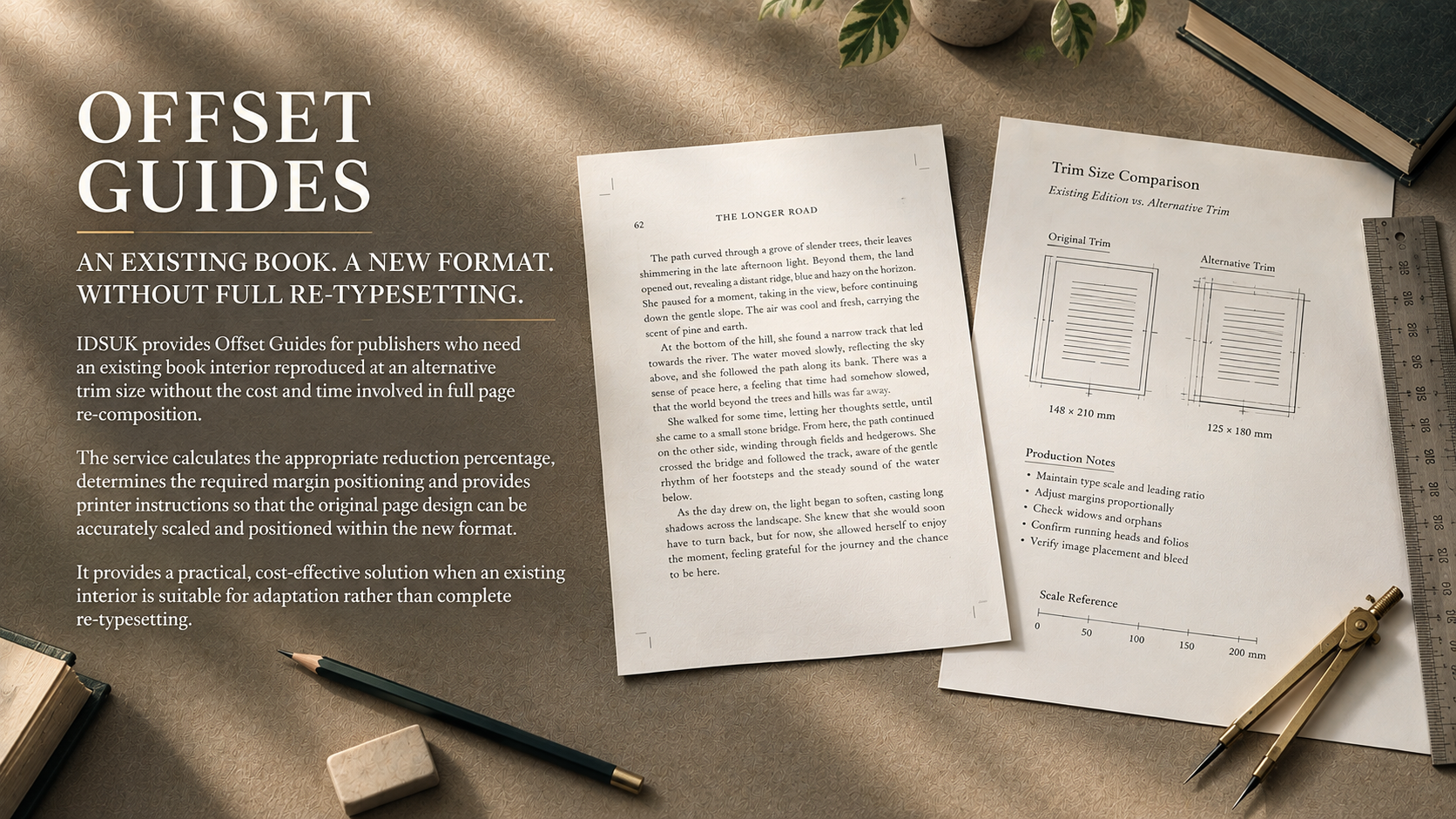
The purpose of an Offset Guide is to make practical use of an existing interior design rather than automatically starting the typesetting process again.
Where the original design is suitable, this can avoid unnecessary page re-composition while allowing the publication to be produced at a different trim size.A COST-EFFECTIVE ALTERNATIVE
For suitable projects, an Offset Guide can provide a more economical alternative to completely re-typesetting an existing book interior.
The appropriate approach depends on the original files, the existing page design, the new trim size and the printer's requirements.
THE DETAIL MATTERS
Scaling a publication is not simply a matter of reducing a percentage.
The relationship between the original page dimensions, margins, trim size and printer requirements needs to be considered carefully so that the resulting production instructions are clear and usable.
DISCUSS AN OFFSET GUIDE PROJECT
If you have an existing book interior that needs to be reproduced at an alternative trim size, tell us the original format and the new format you require.
We can discuss whether an Offset Guide is appropriate for the project.